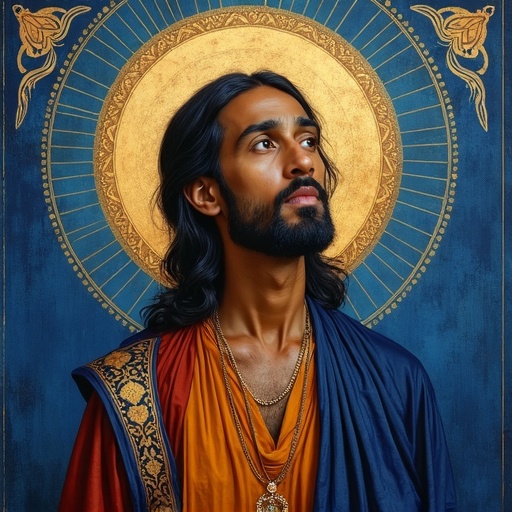
Jai Uttal met Neem Karoli Baba at 19 without planning to, discovering the guru through reading. Rather than relying on memory, Uttal maintains his connection through daily practice—sitting with Maharaji's picture and reciting his name. He shares a transformative dream that occurred during a low point in Allahabad, where he encountered Maharaji at a deserted train station. The dream, verified by the exact time Maharaji physically arrived at the station (1:20 a.m.), became the "stamp" that anchored his faith through decades of doubt and continues to ground him through life's ups and downs.
How Did You First Meet Your Guru?
At 19 years old, Jai Uttal traveled to India without any intention of meeting Neem Karoli Baba—often called Maharaji. He had encountered the guru's name through reading, particularly through books by others in the lineage, but the meeting itself was unplanned. That openness to encounter, stepping into India without a rigid agenda, set the stage for what would become one of the defining relationships of his life.
What Keeps You Connected When Life Falls Apart?
When asked what sustained him through difficult periods, Uttal emphasizes something crucial: the connection is not primarily a memory, but a practice. He sits in front of Maharaji's picture and recites his name—and when he does, the guru "is never not there." The emotional and heart connection that fades over the course of a day, that slips from awareness during the noise of living, becomes "very strong once again" in those moments of direct practice. This is not sentimentality; it is a tangible, repeatable experience (starting around 52 seconds in the talk).
The practice of nama—recitation of the guru's name—appears here not as a magical formula but as a reliable anchor that returns consciousness to the relationship. What Uttal says matters: the heart connection is forgotten "10 minutes prior," which is to say, constantly, in the texture of daily life. The practice restores it.
What Story Most Shaped Your Understanding of Discipleship?
The story Uttal shares takes place roughly one month into his time in India, and the circumstances are worth noting for their ordinariness—which is precisely what makes them representative. He was in Allahabad, a northern Indian city famous for the Kumbha Mela, waiting for Maharaji to arrive at a specified time. The setup: Uttal was broke, recently dumped by his girlfriend, ill with dysentery, and homeless, crashing in the house of strangers he'd met (around 102 seconds). Every day he would go to the house where Maharaji was supposed to appear. Every day, the guru didn't show up. Nobody knew when he would arrive.
This is the crucial context for what follows. Uttal was not in a state of exultant devotion. He was low. Questioning. "Why did I come to India?" he recalls thinking. This is the psychological ground from which the dream emerges.
One night, sleeping in a sleeping bag in the corner of the room, he dreams: He stands at the Allahabad railroad station—completely deserted, which he notes is impossible (Indian train stations are never empty), which is how you know it's a dream. A train arrives and stops directly in front of him. Maharaji emerges, wrapped in a blanket, descends the steps, and opens his arms. Both men weep. Maharaji speaks: "Finally you've come back to me. Finally you've come back. Finally you've come back." In that dream-embrace, Uttal feels a profound knowing: this man has been "my protector, my savior, for so so so many lifetimes" (starting around 220 seconds).
Uttal wakes and checks the clock: 1:20 a.m.
The next morning, everything at the house is different. People are moving with purpose. He asks a young man what has changed. The answer: "Maharaja arrived last night by himself at the Allahabad station at 1:20, and he called us to pick him up." The time matches exactly (around 268 seconds). The physical arrival corresponds to the dream arrival, down to the minute.
Why Does This Dream Matter After So Many Years?
Uttal's reflection on the significance is worth examining closely. He says: "I knew from the dream finally that this was my guru." But then he adds something subtle: "At the time I felt I didn't need that stamp, but I know myself and I know the way my mind works—that over the years a million times I would have said to myself, 'I was just a dream, you know, forget about it, it's not real.'"
The dream, corroborated by the external fact of Maharaji's arrival at exactly 1:20 a.m., becomes what he calls "the stamp"—proof not for others, but for his own mind. It is an inoculation against the doubt that will arise countless times over decades. Uttal is honest about his own psychology: without that confirmation, his rational mind would have rationalized the dream away. The coincidence of the precise time, the fact that something impossible to dismiss anchors the relationship at a moment when faith is thin, means the memory sits in his heart and "faces down all my doubts and all my insecurities" (around 311 seconds).
This points to something subtle about the guru-disciple relationship. It is not maintained by continuous ecstatic experience, but by a bedrock of verified encounter—something real that the intellect cannot entirely dismiss—combined with repeated daily practice. The dream and the arrival time form the foundation. The daily sitting with the photo and the recitation form the structure.
What Is the Role of Verified Experience in Spiritual Life?
Uttal's story reveals something contemporary teaching sometimes obscures: the importance of grounding in fact. He does not ask his listener to accept the dream as proof of anything metaphysical. Rather, he uses the synchronicity—the measurable correspondence between the dream-time and the physical arrival—as his own touchstone. The guru did not need to perform a miracle or announce himself in the dream. The guru appeared in the form Uttal needed at that moment: as a weeping protector from many lifetimes, offering the embrace of return.
The stamp, the verification, is not what creates the relationship; it clarifies and confirms what is already arising in the heart. The dream alone might fade. The arrival alone might be coincidence. Together, they form an undeniable thread that can be pulled taut whenever doubt knots itself in the mind.
Where to Go From Here
For practitioners of bhakti (devotional) paths, this talk offers several practical strands. First: the guru relationship often begins without planning, through what might be called grace or chance, but the recognition of the relationship deepens through both verified experience and daily practice. Second: in periods of crisis, doubt, or low faith, the practice of reciting the guru's name and sitting with their image is not a retreat into memory but a real restoration of heart-connection. Third: if you have had moments of profound recognition or inexplicable synchronicity with a spiritual teacher, those moments are not required to be "real" in a provable sense to function as anchors for faith; they serve the psyche and the heart in the way they need to be served. Uttal's honesty about his own doubt-prone mind suggests that such moments, held consciously, protect against the mill-grinding of years and the wear of inevitable disappointment.