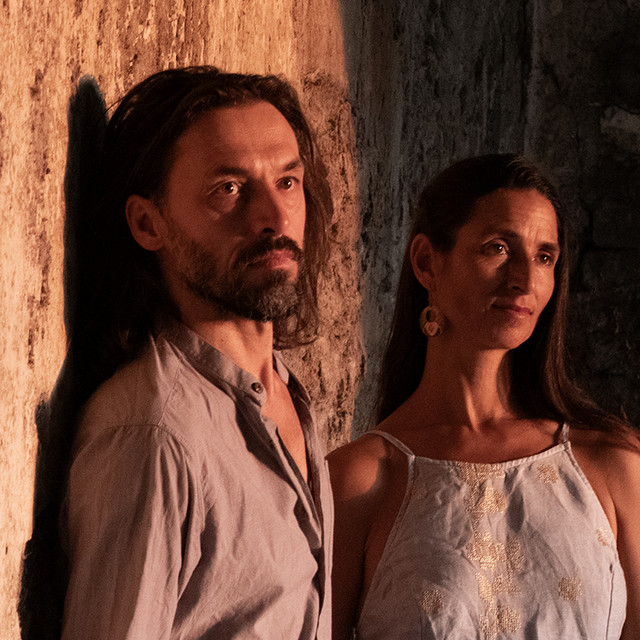
Mirabai Ceiba's "Ocean of My Dreams," from the album Between The Shores of Our Souls, is a devotional music video that weaves together Rumi's Sufi poetry with contemporary bhajans and kirtan. The track fuses Hindu devotional tradition with Islamic mystical verse, creating a cross-spiritual meditation on the soul's longing for divine union. Produced by Jamshied Sharifi and filmed with ethereal underwater imagery by photographer Elena Kalis, the song explores themes of spiritual surrender, transcendence, and the dissolution of ego into the infinite—core themes in both bhakti yoga and Sufi mysticism.
What Are Bhajans and Kirtan in Spiritual Music?
Bhajans are devotional songs rooted in Hindu and Indian spiritual traditions, typically sung in call-and-response or choral formats. Kirtan is a related practice—communal chanting of sacred mantras, names of the divine, or devotional verse. Both forms are designed to shift consciousness through repetition, melody, and collective devotion. They are not performance art in the conventional sense but rather a spiritual technology for opening the heart and aligning the singer and listener with transcendent presence.
Mirabai Ceiba's work sits at the intersection of these Eastern traditions and world music. By pairing traditional bhajan instrumentation and vocal styles with Rumi's medieval Persian Sufi poetry, she creates a bridge between Hindu bhakti (devotion) and Islamic mysticism—two paths that, while historically and culturally distinct, share a common aim: the annihilation of the separate self and union with the Divine.
Who Is Mirabai Ceiba and What Is Her Musical Lineage?
Mirabai Ceiba is a Grammy-nominated musician and kirtan artist known for her ethereal, meditative approach to devotional music. Her practice combines traditional mantras and bhajans with contemporary world music production, making sacred Hindu and Sufi texts accessible to Western audiences. The name "Mirabai" references Mirabai, a 16th-century Hindu saint-poet and mystic who was renowned for her ecstatic devotion to Krishna. By taking this name, Ceiba aligns herself with a lineage of women mystics who chose direct spiritual experience over social convention.
Ceiba's music has been featured in documentaries, yoga spaces, meditation centers, and spiritual retreats globally. Her approach emphasizes that devotional music need not remain bound to a single religious or cultural framework—instead, it can serve as a universal language of the heart, translating ancient wisdom into forms that contemporary listeners can engage with authentically.
How Does Rumi's Poetry Inform "Ocean of My Dreams"?
Rumi (1207–1273) was a 13th-century Persian poet, theologian, and founder of the Mevlevi Order (known as the "Whirling Dervishes"). His poetry is saturated with metaphors of longing, surrender, and the soul's yearning to return to its source—God, or the Beloved. Common Rumi themes include the ocean as a symbol of the infinite Divine, the drop dissolving into the sea as an image of ego-death, and the journey of separation and reunion with the Absolute.
In "Ocean of My Dreams," the title itself evokes a Rumi-inspired metaphor: consciousness as an ocean, both vast and intimate, both external and interior. The "dreams" reference suggests the illusory nature of ordinary perception—in both Sufi and Advaita Vedanta philosophy, the material world is understood as a divine dream from which awakening reveals one's true nature. The song invites the listener into this dream-ocean, suggesting that spiritual practice is not about escaping the dream but about recognizing its dreamer.
What Is the Relationship Between Bhakti and Sufism?
Bhakti (devotional practice) in Hinduism and Sufism in Islam, despite arising in different cultures and religious frameworks, share fundamental features: an emphasis on heart-centered devotion over intellectual knowledge, the practice of sacred music and poetry as vehicles for spiritual transformation, and the goal of direct experience of the Divine. Both traditions produced ecstatic saints, both value the surrender of the ego, and both use metaphors of love and longing to describe the soul's relationship with God.
Mirabai Ceiba's work honors both lineages without diluting either. Rather than treating them as equivalent (which would be spiritually and historically inaccurate), she allows them to resonate together—much as a skilled musician can play two instruments in harmony while respecting each one's distinct voice. This approach suggests that the deepest spiritual insights transcend religious boundaries, even as they require rooting in specific practices and traditions.
What Do the Visual Elements Communicate?
The music video features ethereal underwater imagery, photographed by Elena Kalis, whose work is known for capturing the intersection of human consciousness and natural beauty. Water imagery is integral to both Sufi and Hindu spiritual symbolism: water represents fluidity, dissolution, the formless state, and the medium through which light refracts and becomes visible. In Sufi poetry, the lover dissolves into the Beloved as a drop of water dissolves into the ocean, losing its separate form yet remaining present within the whole.
The visual meditation of underwater scenes—where human figures appear suspended, weightless, and integrated with their environment—reinforces the song's lyrical themes of surrender and transcendence. The body is not shown as separate from nature but as permeable, as part of an interconnected whole. This aesthetic choice makes the abstraction of spiritual experience tangible; viewers can feel what dissolution and unity might look like, even if they cannot fully articulate it in words.
How Does Production Enhance the Spiritual Intention?
The production by Jamshied Sharifi—a composer and producer known for his work on film scores and world music—suggests a cinematic, immersive approach. Rather than stripping music down to bare components (a choice some classical kirtan practitioners prefer), Ceiba's production adds lush instrumentation, electronic textures, and atmospheric effects. This is not a contradiction of tradition but an evolution of it.
Historically, devotional music adapted to whatever instruments and technologies were available in its time and place. Indian classical music incorporated Persian influences; Sufi music incorporated local instruments and folk traditions. In the modern era, synthesizers, recording technology, and studio production are simply the new vessels for the same intention: to move the listener's heart toward the Divine. A well-produced bhajan can be as spiritually effective as a live performance, provided the intention and presence of the musician remain central.
What Does "Between The Shores of Our Souls" Suggest About the Album?
The album title Between The Shores of Our Souls is itself poetic and metaphysically rich. The "shores" suggest boundaries, yet "between" them is the ocean—unbounded space. The phrase implies that the individual soul (or atman, in Hindu terminology) is both distinct and connected, both singular and universal. It suggests a geography of consciousness where separation and unity coexist, where the soul is not one unified thing but a landscape traversed between known and unknown territories.
This framing signals that Ceiba's album is not attempting to deliver final answers or closed spiritual teachings. Instead, it invites the listener to inhabit the space of questioning, longing, and gradual revelation—the liminal space where spiritual transformation actually occurs. The music becomes a companion for that journey rather than a destination.
How Can Listeners Engage Spiritually with This Music?
Devotional music is most effective when listened to with intention. Rather than treating "Ocean of My Dreams" as background music, practitioners can:
- Create sacred space: Light a candle, sit upright, and give the song your full attention.
- Sing along: If comfortable, vocalize with the track. Chanting activates different neural pathways than listening alone and deepens the meditation.
- Contemplate the metaphors: As you listen, hold the image of the ocean—vast, fluid, containing multitudes yet unified—and reflect on where you experience that boundlessness in your own consciousness.
- Return to it repeatedly: Devotional music works cumulatively. Returning to the same track over weeks or months deepens its effects as your relationship with it evolves.
- Research the sources: Reading Rumi's poetry or learning about bhakti philosophy enriches your listening and connects you to the larger tradition Ceiba is drawing from.
Why Does Devotional Music Matter in a Secular Age?
In cultures shaped by materialism and secular rationalism, devotional music serves a crucial function: it legitimizes the inner life, the heart's longing, and the reality of non-ordinary consciousness. A song like "Ocean of My Dreams" is not arguing that mystical experience is real—it embodies that reality, inviting the listener to participate in it directly through sound, image, and feeling.
Neuroscience has begun to validate what contemplative traditions have always known: chanting, mantra, and devotional music activate the parasympathetic nervous system, lower cortisol, increase coherence between brain hemispheres, and create states associated with meditation and prayer. Yet the value of such music transcends its measurable effects. It points toward dimensions of human experience that science can describe but not ultimately explain: meaning, beauty, love, and transcendence.
Where to Go from Here
If "Ocean of My Dreams" resonates with you, deepen your engagement by exploring the full album Between The Shores of Our Souls, available through Mirabai Ceiba's official channels. Follow her work through her website at mirabaiceiba.com, or connect through her social media (Facebook, Instagram, Twitter) for updates on new releases and live performances.
To understand the Rumi connection more deeply, read translations of his work—Coleman Barks' translations are widely available and accessible to Western readers. Explore the Mevlevi Order and the Whirling Dervish tradition to understand how Sufi devotion is embodied in movement and ceremony. On the bhakti side, study the lives and songs of Hindu saints like Mirabai (the historical figure), Kabir, and Tulsidas to understand how Indian devotional music developed and what it meant in its original context.
Finally, consider how you might bring devotional music and sacred chanting into your own practice. Whether through attending kirtan circles, learning mantras, or creating your own contemplative listening practice, engaging with music as a spiritual technology can open dimensions of consciousness that words alone cannot reach. The ocean awaits—not as a destination, but as the medium in which we have always been swimming.


