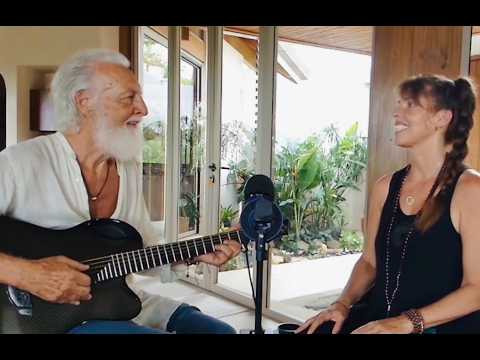
Om Purnam is one of the most revered Sanskrit mantras in Hindu and Vedic traditions, expressing the concept of cosmic completeness and wholeness. This article explores the mantra's meaning, its origins in the Upanishads, and the spiritual benefits of chanting it—drawing on a live performance of Om Purnam recorded by kirtan artists Deva Premal and Miten in Byron Bay, Australia. The mantra embodies the principle that all existence is full, complete, and unified, making it a foundational practice for those seeking to align with the essential nature of reality.
What Does Om Purnam Mean?
Om Purnam is composed of two Sanskrit elements: Om, the primordial sound representing ultimate reality or Brahman, and Purnam, which translates to "complete," "whole," or "full." Together, the mantra affirms that all of existence—visible and invisible—is whole and complete. This is not merely a philosophical statement but an invocation of direct experience: the recognition that nothing is lacking in the fundamental nature of reality.
The mantra often appears in fuller form as part of the Isha Upanishad, one of the oldest Hindu philosophical texts: "Om Purnam adah, Purnam idam, Purnat Purnam udachyate. Purnasya Purnam adaya, Purnam evavashishyate." Translated, this reads: "That is whole, this is whole. From wholeness, wholeness comes. Taking wholeness from wholeness, wholeness remains." This teaching suggests that completeness cannot be diminished—an expression of non-duality fundamental to Advaita Vedanta philosophy.
Why Is Om Purnam Central to Mantra Practice?
In kirtan traditions, Om Purnam serves as an anchor mantra—one that can open a meditation session or be chanted repeatedly to establish a meditative state. When Miten and Deva Premal introduce the evening with Om Purnam, they are invoking a foundational truth before moving into deeper devotional or contemplative practice. The mantra's simplicity belies its depth: by repeating "Om Purnam," a practitioner attunes their mind and body to the vibration of completeness itself.
The benefits of chanting Om Purnam include:
- Calming the nervous system: The prolonged "Om" sound activates the parasympathetic nervous system, inducing relaxation and reducing stress.
- Shifting perspective on lack: Regular chanting can dissolve the psychological sense of scarcity and incompleteness that drives anxiety and grasping.
- Aligning with cosmic order: Sanskrit mantras are understood in Vedic science to carry vibrational frequencies that attune individual consciousness to larger universal patterns.
- Preparation for deeper practice: Beginning a meditation or kirtan session with Om Purnam creates a cohesive group field and settles the mind before more complex chanting.
How Did Deva Premal and Miten Present Om Purnam?
In their live performance recorded in Byron Bay, Australia (from the album Dakshina), Deva Premal and Miten sing Om Purnam three times, inviting the assembled audience to chant along. This call-and-response approach—where the teacher or guide leads and the group follows—is central to the kirtan tradition. The repetition creates a unified sonic field, where individual voices dissolve into collective resonance.
The three-fold repetition is intentional. In Hindu practice, the number three carries significance: it reflects the three states of consciousness (waking, dreaming, deep sleep), the three gunas or qualities of nature (sattva, rajas, tamas), and the trinitarian aspects of divinity found across many spiritual traditions. By chanting the mantra three times, practitioners are honoring this sacred structure while allowing the vibration to deepen with each repetition.
What Is the Dakshina Album?
The album Dakshina from which this performance is taken represents Deva Premal and Miten's approach to making sacred Sanskrit chanting accessible to contemporary audiences. Dakshina refers to an offering or gift given to a teacher in gratitude, reflecting the spirit of the album itself—offering traditional Vedic wisdom to those seeking spiritual practice in the modern world. The live recording in Byron Bay captures the spontaneity and communal energy of kirtan in action, where the boundary between performer and participant becomes permeable.
How Can You Practice Om Purnam?
To integrate Om Purnam into your own practice, begin by finding a quiet space and sitting in a comfortable, upright position. Take a few deep breaths to settle your nervous system. Then, inhale deeply and chant "Om" on the exhale, allowing the sound to resonate through your chest and head. On the next breath, chant "Purnam," elongating the syllables. Repeat this pattern for 5 to 15 minutes, or as long as feels natural.
Some practitioners use a mala (a string of 108 beads) to track repetitions, completing one full round at 108 chants. Others prefer to chant Om Purnam for a specific duration—perhaps 10 minutes each morning—allowing the vibration to set the tone for the day. The key is consistency and presence: chanting with attention to the meaning and the sensations arising in the body amplifies the mantra's effects.
Where to Go from Here
If Om Purnam resonates with you, consider exploring the Isha Upanishad in full to understand the philosophical context of this mantra. You might also investigate other foundational mantras like So Hum (I am that), Om Mani Padme Hum (the jewel in the lotus), or Gayatri Mantra, each offering different doorways into Vedic wisdom. Deva Premal and Miten's broader catalog of kirtan recordings provides a comprehensive introduction to Sanskrit chanting and devotional practice. For those seeking live experience, attending kirtan sessions or retreats allows you to experience the collective resonance that emerges when many voices chant together—a dimension of mantra practice that cannot be fully captured in solitary practice.