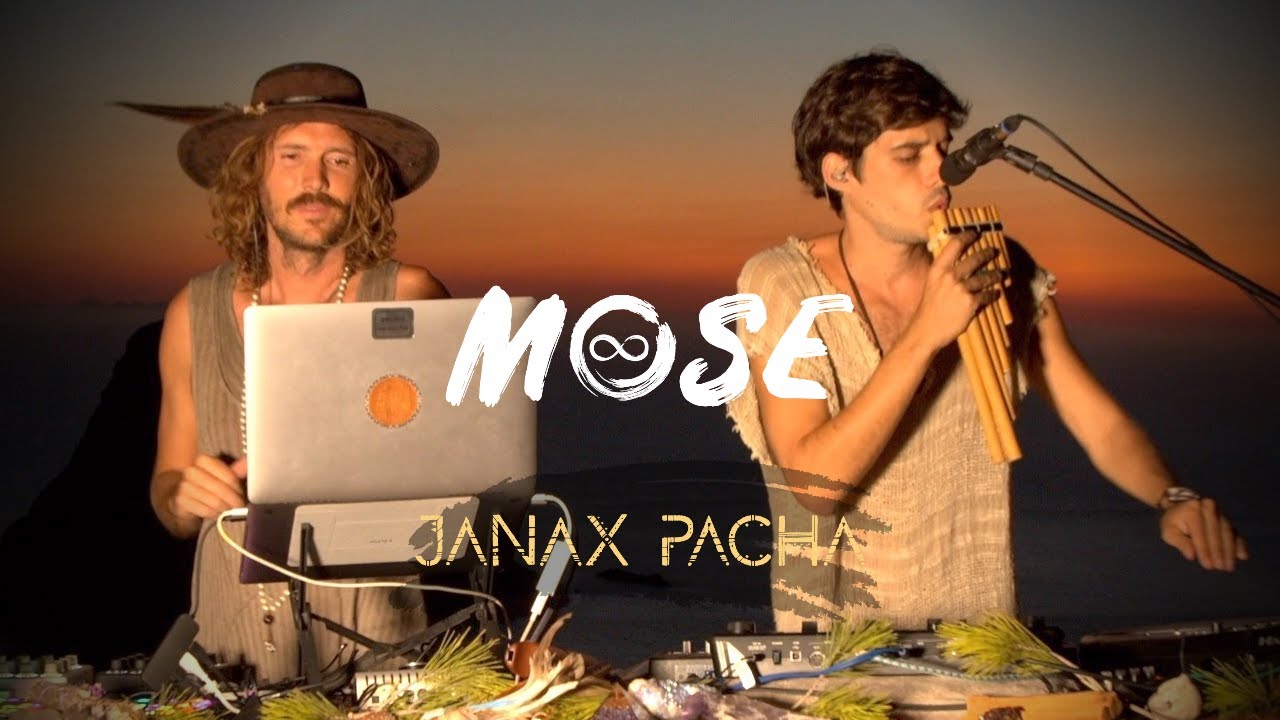
Mose's live set from Envision Festival 2019 in Costa Rica showcases a full 104-minute performance built entirely on live loops and improvised instrumentation with three accompanying musicians (Darren Austin Hall on vocals, Marcelo Berges on guitar, and Chris Assaad on vocals). The set interweaves electronic remixes of world and spiritual music—including works by Poranguí, Nalini Blossom, and Jackson Lewis—with real-time vocal and instrumental responses, creating a collaborative journey designed to resonate with an audience described as having open hearts and minds. This performance model, combining pre-composed remixes with spontaneous ensemble play, reveals how electronic music production and live musicianship can merge into a form of musical meditation.
What makes live loop performance different from a DJ set or studio recording?
Mose's Envision performance operates in a specific tradition that sits between DJing and ensemble musicianship. Rather than simply curating and mixing pre-made tracks—the conventional DJ model—Mose uses loops as a compositional foundation that the live ensemble then actively interprets. The distinction is crucial: loops function here not as fixed playback but as a living canvas upon which each musician (vocalist, guitarist, and additional vocalists) can layer, respond to, and reshape the sonic texture in real time.
In a traditional DJ set, the primary energy flows from one operator selecting, beatmatching, and mixing tracks. In a studio recording, the performance is captured once and fixed in its final form. Mose's approach positions the electronic loops as a launching point—they provide structure, harmonic foundation, and rhythmic anchor—but the live musicians respond to the energy of the crowd and to each other's contributions in ways that cannot be predetermined. The vocal improvisations, the guitar phrasing, the textural shifts: these emerge from the moment. This creates a unique form of liveness even within heavily electronic music.
The set description notes that all three accompanying musicians are "great musicians in their own right," which is essential to understanding the performance's depth. This is not a setup where Mose controls everything and guest vocalists simply add flavor; rather, it is a genuine collaboration where each person's musical intuition and skill shapes the outcome. The set was described by Mose as created "from a similar space and with a similar format" to his earlier live work "Mose ft. Suyana - Live at Heartculture," suggesting this is a deliberately cultivated approach to performance rather than a one-time experiment.
How do remixes function within a live improvised context?
The track list reveals that Mose did not simply play original compositions; rather, he remixed existing pieces—many from artists like Poranguí (whose tracks appear three times: "Stardust," "Otorongo," and "Oxum"), Nalini Blossom ("Soul Flight"), and others. These remixes serve as the scaffolding for the improvisation.
In electronic music production, a remix typically recontextualizes an original song—changing its arrangement, adding new instrumentation, adjusting tempo or harmonic emphasis. When Mose created these remixes, he was likely reimagining the harmonic and rhythmic frameworks of the source material to suit a live ensemble setting. A remix of "Stardust" by Poranguí might strip the original down to essential melodic or harmonic elements, leaving room for live vocalists and guitarists to fill the space. Conversely, it might add new layers that the live musicians then play against.
The presence of unreleased remixes (three Poranguí remixes marked as "[unreleased]") suggests that these versions were crafted specifically for this event or for this performance format. Mose did not reach into an existing catalog of remixes; he created fresh arrangements designed to work with live ensemble play. This is a crucial point: the remixes are not finished products being performed; they are working documents that make room for the live musicians to contribute meaningfully.
Tracks like "Cura Corazon" (co-created with Matia Kalli) and "Ocean of Silence" (with Michael Ben Shimon) appear to be collaborative pieces already, suggesting Mose works within networks of musicians who share similar aesthetic and spiritual sensibilities. The collaborators on the released tracks overlap with those performing live, creating a web of artistic relationship that deepens the coherence of the set.
What role do spiritual and world music traditions play in the sonic narrative?
Several elements in the track list point toward specific musical and spiritual traditions. Poranguí, a Peruvian electronic musician, blends Amazonian indigenous elements with ambient and electronic production. Nalini Blossom, Hanuman Project, and the Krishna-focused chanting references ("Radhe," "Govinda," "Jaya") indicate the set draws on Hindu devotional music and kirtan traditions. The inclusion of "Oxum"—a reference to the Orisha in Yoruba and Afro-Brazilian spirituality—signals engagement with African diaspora spiritual traditions.
These are not superficial references. They suggest that Mose constructs sets as spiritual and musical journeys that honor multiple wisdom traditions. The ambient and electronic production contexts these traditions within a contemporary sound world; the live vocalists then bring embodied, human presence to what might otherwise remain abstract or distant. When Darren Austin Hall, Marcelo Berges, and Chris Assaad sing devotional or spiritually resonant phrases, they activate the traditions referenced in the remixes.
The audience description—"a really beautiful group of people ready to receive these vibrations with a totally open heart and mind"—is not rhetoric; it describes the intentional curation of sonic and spiritual content. The music is designed not merely to entertain but to facilitate a state of openness or receptivity. This places the performance within a lineage of sacred music and conscious electronic music that takes listener transformation as part of its implicit goal.
How does collaborative ensemble improvisation differ from solo performance?
A solo performer—whether electronic musician, instrumentalist, or vocalist—must hold the entire arc of a performance within their own awareness. They choose tempos, build and release tension, and respond to audience energy as an individual agent. This has its own power and clarity, but it also means the performer carries the full responsibility and intention.
When Mose performs with Darren Austin Hall, Marcelo Berges, and Chris Assaad, the attention, intention, and creative decision-making become distributed across multiple people. One person might feel the need for textural restraint while another senses that more volume and complexity is needed. One vocalist might intuitively sense a harmonic resolution another has not yet reached. A guitarist might respond to a vocal line with a counter-melody that surprises everyone, including Mose.
This creates a collective intelligence that can exceed what any individual performer would produce alone. It also introduces genuine uncertainty: no one person knows exactly what will happen next. For performers and audience alike, this uncertainty is generative. It demands presence. It prevents the performance from becoming merely skilled execution of a pre-planned route; instead, it requires real listening and real response in each moment.
Mose's framing—"it was really fun to collaborate with them and weave this journey for a really beautiful group of people"—emphasizes the quality of "weaving," a metaphor suggesting that each musician contributes a thread that the others then weave together. The result is not Mose's design with guest performers; it is genuinely co-created. This distinction is important for understanding the ethical and creative stance of the performance. It is not extractive (taking energy or skill from others) but generative (creating something new that none of the individuals would make alone).
What is the function of silence, breath, and space in electronic and ensemble music?
One of the track titles—"Ocean of Silence" (with Michael Ben Shimon)—is suggestive. In electronic music, silence and space are often treated as compositional elements rather than mere absences. A sudden drop into near-silence, a few seconds of ambient sound with minimal harmonic content, or the removal of beat and rhythm can serve as a form of punctuation or reset.
Within a live ensemble setting, silence becomes even more crucial. It is the space in which one musician's phrase ends and another's begins. It is the moment where the collective attention recalibrates. A vocalist might finish a phrase and hold silence for a breath while the guitarist shapes a response. In those gaps, real listening happens. Without silence, an ensemble performance can become a cacophony of simultaneous intentions. With intentional silence, it becomes a conversation.
The transcript, while difficult to parse (consisting mostly of musical notation placeholders), does contain fragments suggesting this principle in action: words like "my soul," "children of Gaia," "remember," and "home" emerge in the vocal parts. The sense is of spoken or sung phrases arising from the musical texture, then receding back into it. This on-and-off relationship between word and music, presence and silence, is characteristic of sacred or meditative musical practice.
Where to go from here
To deepen engagement with this performance model, consider exploring the individual musicians: Darren Austin Hall, Marcelo Berges (who performs as Prizma), and Chris Assaad each have their own releases and performance styles. Their separate catalogs will show what each brings as an individual artist to the ensemble context. Mose's Patreon offers access to similar live recordings and mixes, providing continuity with this Envision set.
The Envision Festival itself is a notable venue for this kind of work, programming electronic music, kirtan, live performance, and spiritual teaching into a coherent event structure. Understanding the festival's curatorial vision helps explain why Mose's approach—collaborative, improvisational, rooted in multiple spiritual traditions, electronic yet embodied—resonates there.
For those interested in the relationship between electronic music production and live performance, Mose's use of remixes as the basis for live improvisation offers a model worth studying. It suggests that electronic production need not be opposed to liveness or spontaneity; instead, it can serve as a tool that enables new forms of ensemble musicianship. The future of sacred and conscious music may lie precisely in this fusion: production sophistication meeting real-time human responsiveness.